Thursday, November 10, 2016

Taming Poison Ivy's Itch.


It is no secret that direct contact with poison ivy causes an uncomfortable agonizing itch. How this happens is still not clearly defined. As reported in ACS News online, Sven-Eric Jordt of Duke university pinpointed a molecular pathway that helps transmit an itch signal through nerve cells by exposing mice to poison ivy’s oily allergen urushiol. Two commonly prescribed drugs to fight the poison ivy itch are antihistamines and corticosteroids. Unfortunately antihistamines seem to not work and although corticosteroids fight inflammation they are ineffective against itch.  Jordt looked for genes that were transcribed at higher levels in mice whose skin was brushed with urushiol compounds compared to non-exposed mice. 

As expected several genes associated with inflammation were up regulated in the infected mice, but Jordt focused on one particular gene that codes for the protein interleukin-33, associated with itchy skin. When the exposed mice were given antibodies against IL-33, the mice slowed their scratching significantly. When exposed mice were given antibodies against IL-33’s receptor, ST2, which is located on sensory neurons that connect to the animals’ skin, also significantly reduced itching.  Researchers suspected a link such as this one but did not know the specifics. Even though a molecular pathway for itch is complicated, these systems will share features important for future drug design. Jordt’s team hopes to work with clinicians to see if they can detect IL-33 in humans with poison ivy.

Thursday, November 3, 2016

Bio batteries

Many things that we own run on batteries. Your phone, computer, and car all need a battery. Batteries that we have now are ridig, bulky, can overheat, and leak.  Researchers from the Renselaer Polytechnic Institute are research bio batteries. These new batteries uses bodily fluids such as blood, sweat, and even urine. So they could be inserted under the skin without any discomfort. They would continue to work as long as you keep eating. The batteries are thin like paper because they are much like paper.

They are 90% paper and 10% carbon nanotubes. The carbon nanotubes are what give it its conductive abilities. Advantages are that the battery is thin, light weight and can be cut into different shapes. When a few of them are bundled together they can be used to power medical implants. They can resist low temperatures and high temperatures up to 300 degrees Farhenheit. As well as a battery it can act as a high energy capacitor. I would assume that people would become concerned with how far the application would be taken by the commercial market if the battery can become strong enough to power something like a cell phone. That could lead to people start having a phone as part of there body which sounds cool but also dangerous at the same time
The link to the article is below
http://electronics.howstuffworks.com/everyday-tech/blood-battery.htm

The Chemistry of Fall Colors

The colors of fall prompt many an expedition into the countryside this time of year.  Leaf "peeping" tourism is economically important in New England.  But why is it that leaves change to such a variety of colors in the fall.  Joanna Klein outlines the chemistry of the color changes in a recent article in the New York Times.  As the days get shorter and the temperatures drop the chlorophyll in the leaves that collects sunlight and uses the energy to convert carbon dioxide into sugar begins to break down.  The yellow colors we see are the carotenes (see below) that have been there all the time.


                               Margaret Gould did some "leaf peeping" in Albany last week.

The red colors, however, come from anthocyanins (see below) that the leaf makes from stored sugar.  A number of theories have been proposed for why the leaf expends resources to make these anthocyanins.  One theory, for examples, proposes that the anthocyanins absorb blue and uv light that might damage the leaf at a time when it still has important work to do.  As it dies the leaf must transfer its stored sugar and other nutrients to the bark and roots of the tree.  Note that both classes of compounds have the kinds of extensive systems of alternating double bonds characterisitic of visible light absorbing (and therefore colored) molecules.

beta-carotene

Anthocyanins are glycosides of anthocyanidins, the
basic chemical structure of which is shown here


Ozone is Back!

According to recent findings from climate scientists, the ozone layer is really beginning to show signs up healing.  A recent CNN article has reported on the ozone layer's resurgence.  Although the ozone layer is healing very slowly, the hole is becoming smaller and smaller, with its maximum depletion occurring around the year 2000.


For those who do not know, in 1989 chemicals that caused the depletion of ozone in the atmosphere was banned in the Montreal Protocol.  The main type of chemical banned was the chlorofluorocarbon.
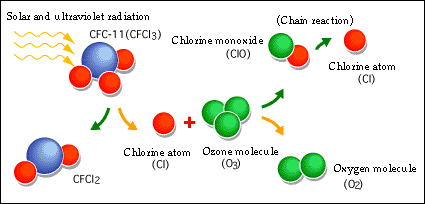
CFC
This chemical turns ozone (O3) into gaseous oxygen.  Ozone is very necessary in our atmosphere to protect ourselves from dangerous ultraviolet light.  Without ozone, the UV light is able to penetrate the atmosphere all the way to the surface where it can cause increased rates of skin cancer, disease, as well as cause increased heating to our earth's surface.  
The dangerous chemical's effects were only discovered in 1985, and officials acted quickly to ban the compound from use in everyday materials such as refrigerators, hair sprays, and aerosols.  Since then, other propellants have been used that do not pose a risk to the ozone layer, or other parts of the protective atmosphere around the earth. Some of these replacement chemicals include Hydrochlorofluorocarbons (these still deplete ozone, but at a much slower rate) and hydrofluorocarbons, which have an ozone depletion potential (ODP) of 0. 

The swift movement from the discovery of the problem to the action to eliminate the dangerous chemical shows how a successful mission can be accomplished on the world stage regarding science and chemistry.  I believe that this should be a model to the way we treat our energy systems with fossil fuels being a large polluter and greenhouse gas emitter into our air. We understand the negative effects of burning fossil fuels and how it affects the environment.  Therefore, it is incumbent upon us to begin the process of eliminating the burning of these ancient compounds in our every day lives, and begin a movement to more clean and renewable sources of energy for the public. We are already seeing companies like Tesla push the boundaries on affordability of electric cars and household battery systems. 

The actions of the UN and countries around the world with on the ozone layer depletion should be a model for further safety and environmental management in the world.  We have seen that using science to pinpoint a problem and create a solution for the environment works, so why stop now?

Wednesday, October 26, 2016

Wonder Patch

        When the hot weather of summer comes around, what is the most annoying and itch-inducing creature that comes to life? This creature would be the mosquito. They make you itchy after they bite you and are known to be the number one killing machines in the world. The saliva of the mosquito is an anti-coagulant, where histamine enters the skin and the swelling begins. One of the various diseases that is transmitted by mosquitoes is malaria. In the United States and other first world countries, we do not have the severe problem as countries that are less fortunate. To prevent mosquitoes from biting us, we have created many products that are not as effective as advertised. This is because sometimes the products are filled with harmful chemicals. 


          Dr. Anandasnkar Ray of University of California Riverside, has found a solution with the help of his research team and financial supporters such as Bill Gates and the National Institute of Health (NIH). This solution is a product is called Kite Patch. This small patch blocks the sensors of the mosquitoes from detecting us. In the article, it states that mosquitoes detect human beings by the exhalation of CO2. Mosquitoes are able to detect us from miles away and also use their other senses when they are near us. These patches use unharmful chemicals and odors that disrupt the sensory receptors of the mosquitoes. The idea of the patches came from CO2 emitted by fruits and how fruit flies respond to it. "We found that ripening fruits have simple odor molecules that can block the fruit fly carbon dioxide receptor proteins." They were able to use this idea on the mosquitoes to create the same response. These patches can last between 24 to 48 hours and can be worn on our clothes instead of our skin. 

          As of now, they are still going through some last steps before they can launch this product in the markets. They are testing the patch in Uganda, where malaria is being transmitted by the mosquitoes. One of the last questions they want to answer before the patches can be sold in stores is "will the patches work just as well in the morning as it does at night?" Plus, "will it fall off clothes easily?" And, "would it be as effective in the harsh environment?"  So far, the patches are proven to be outstanding in the confined laboratory.


New Gene-Editing Technology Successfully Cures a Genetic Blood Disorder in Mice

This article describes how Carnegie Mellon University and Yale University scientists have successfully cured a blood disorder in mice using a next generation gene editing system to significantly decrease the amount of unwanted genetic mutations that cause the blood disorder. This is said to be applicable to disorders such as sickle cell and beta thalassemia by affecting hematopoietic stem cells. Carnegie Mellon's Center for Nucleic Acids Science and Technology (CNAST) developed this peptide nucleic acid that runs the entire gene editing system.   


IMAGE

This new systen uses what an FDA approved nano-particle to deliver the peptide nucleic acid shown above along with another donor DNA to repair any genes that are malfunctioning. This is a big step from the old "CRISPR" system that is currently being used. Another problem solved is that these peptide nucleic acids are made to open up the DNA backbone and find a highly specific target without cutting anything. The CRISPR method used restriction enzymes to cleave the DNA. This poses problems for live animals and nonspecific cutting. A donor strand of DNA is required to replace any pieces of DNA that are taken out. This donor strand could be the sequence for a perfectly functioning HBB gene (hemoglobin sub-unit beta gene) and a stem cell factor that enhances the gene editing. All of the testing has been done on mouse and human bone marrow stem cells but has recently injected intravenously to mice with beta thalassemia. The results were an astounding 7% successful gene editing which is up from the .1% it used to be. The researchers designed these peptide nucleic acids with a polyethylene glycol side chain which makes the molecule water soluble. The stereochemistry from the side chain promotes a right handed helix allowing it to bind more readily to DNA.

Thursday, October 20, 2016

How Moss Revealed an undetected air pollution threat in Portland


In this Article, from the PbS news reveal how Moss and Lichens have adverse health effects on humans in general. Moss and Lichens are essentially little sponges that absorb everything in the air around them, including pollutants. Moss had never been studied extensively in an urban environment. A group of scientists from Portland , Jovan, and a colleague decided to study how moss and lichen were affecting the environment the results were shocking to the community. They chose a type of moss called Orthotrichum  that could be found nearly everywhere in the city. 

url.jpg


Moss on tree Trunks.


Follow the link below to the video showing the shocking results of scientist study of Moss in Portland, Oregon.

http://www.pbs.org/newshour/bb/moss-revealed-undetected-air-pollution-threat-portland/#.WAfEcVtnqxs.gmail

Health Effects.
The heavy metal  Cadmium slowly reacts with air to for cadmium oxide. The united states department of Labour stated that "Occupational exposure to cadmium can lead to a variety of adverse health effects including cancer. Acute inhalation exposure (high levels over a short period of time) to cadmium can result in flu-like symptoms (chills, fever, and muscle pain) and can damage the lungs. Chronic exposure (low level over an extended period of time) can result in kidney, bone and lung disease.
Exposure and Control
In a work environment, workers can be exposed to cadmium by breathing in dusts, fumes, or mists containing cadmium. Cadmium or cadmium compounds can also get on the skin, contaminate clothing or food, and be ingested (which is also one of the routes of exposure). The most effective way to prevent exposure to a hazardous metal such as cadmium is through elimination or substitution. 

Cadmium structure 

url.png