https://www.science.org/content/article/helium-3-runs-scarce-researchers-seek-new-ways-chill-quantum-computers
A blog authored by "Chemistry in the Media", a class at the University of Delaware, dedicated to exploring and breaking stereotypes and stigmas applied to science and scientists by the media.
Sunday, April 26, 2026
A Cold Take on Quantum Computers
https://www.science.org/content/article/helium-3-runs-scarce-researchers-seek-new-ways-chill-quantum-computers
Tuesday, April 21, 2026
Chemists Breaking Bad!: The Modern Model for Street Drugs
How Cracking the Code of Party Drugs Dramatically Increased Synthetic Drug Development
Where the problem begins is the discovery of the ease at which alternative drugs with similar effects could be synthesized, a prime example of this being methylone (Figure 2) and its easy addition of oxygen, more specifically a oxygen with 2 bonds to a carbon, known as a ketone.
By the end of 2024 at least 22 nitazene molecules have been identified. The greatest concern with this class of drug is the cost of production and sale being extremely low, as well as the potency. As reported by NPS Discovery, some nitazenes are reported to be 90 times more potent then fentanyl. For reference, morphine, a commonly used drug in the medical world for pain management, is 100 times less potent than fentanyl. This means some nitazenes are 900 plus times more potent than industry standard pain medication!
Saturday, April 18, 2026
Weight Loss by Design: The Chemistry Behind Ozempic
Ozempic has become widely used beyond its original purpose of treating type 2 diabetes, gaining major attention for its strong effects on weight loss. Coverage emphasizes both its medical benefits and the growing controversy around its popularity, including side effects, high cost, limited supply, and debate over non-diabetic use.
At the physiological level, semaglutide works by mimicking the natural incretin hormone GLP-1. This hormone regulates blood glucose and appetite by stimulating insulin secretion when glucose levels are elevated, suppressing glucagon release, and slowing gastric emptying. These coordinated biochemical effects reduce blood sugar spikes and increase satiety.
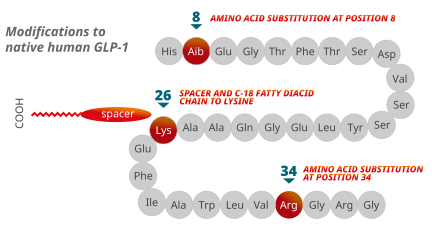
Figure 1. Molecular representation of Ozempic showing how the semaglutide structure is designed to mimic GLP-1 and interact with GLP-1 receptors through specific molecular shape and binding sites. The diagram highlights the importance of structure–function relationships in pharmaceutical chemistry, where small changes in molecular arrangement determine receptor activation, biological response, and drug stability in the body.
The function of Ozempic is fundamentally determined by molecular structure and intermolecular interactions. The active compound, semaglutide, is a synthetically modified peptide composed of amino acids arranged in a specific three-dimensional conformation. This structure is designed through pharmaceutical chemistry to closely resemble endogenous GLP-1 while improving stability.
From a chemical standpoint, the drug’s biological activity depends on molecular recognition, where semaglutide binds to the GLP-1 receptor through highly specific non-covalent interactions such as hydrogen bonding, ionic interactions, and hydrophobic effects. These weak forces determine binding affinity and receptor activation, meaning that even minor structural changes can significantly alter pharmacological activity.
A key chemical modification is the increase in metabolic stability. Natural GLP-1 is rapidly degraded by the enzyme dipeptidyl peptidase-4 (DPP-4), resulting in a very short half-life. Semaglutide is engineered with structural changes that reduce enzymatic recognition and slow degradation, extending its half-life to allow once-weekly dosing. This is an example of structure-based drug design, where molecular modifications are used to control reaction pathways in biological systems.
Media coverage of this medication often reflects a tension between scientific advancement and public concern. Reports highlight significant therapeutic benefits, but also emphasize risks, accessibility issues, and social debates about cosmetic versus medical use.
From a chemistry communication standpoint, the framing can influence perception. When discussion focuses only on side effects, it may reinforce chemophobic thinking, the assumption that synthetic molecules are inherently harmful or “unnatural.” However, when the mechanism is explained in chemical terms, it demonstrates that the drug is a precisely engineered molecule designed for a specific receptor target. This challenges chemophobia by showing that biological effects arise from predictable molecular interactions rather than vague notions of “chemicals being bad.”
This topic is well-suited for a chemistry-in-the-human-environment course because it connects molecular structure, enzymatic reactions, and receptor chemistry to a widely discussed modern pharmaceutical. It also demonstrates how chemical design directly impacts human physiology and how media framing can shape public understanding of chemical science.
https://www.novomedlink.com/diabetes/products/treatments/ozempic/about/mechanism-of-action.html
Tuesday, April 7, 2026
How Funding Cuts Are Disrupting the Next Generation of Chemists
In a typical year, the path to a PhD in chemistry is demanding but predictable. Students in their senior year of undergrad apply in the fall, hear back in the winter, and commit by spring, often April 15th. Typically PhD offers, especially in stem, come with research funding, lab placements, stipends enough to live within the area, and a clear next step into research careers.
With unstable federal research funding: Now is different.
Across the United States, chemistry graduate admissions have been thrown into uncertainty about their futures in academia. Students are being accepted and then waitlisted, others are receiving offers, only to have them rescinded weeks later and some aren't hearing back from all their schools until far after the April 15th commitment deadline, making decisions difficult. Some programs have even quietly reduced their incoming class sizes or have canceled admissions entirely.
Universities rely heavily on federal agencies to fund graduate education in the sciences and these funds don’t just pay for experiments but they support stipends, tuition, and the infrastructure that keeps labs running. Recently, however, funding has become uncertain due to cuts, delays, and policy changes which have left universities unsure of what resources they’ll actually have in the coming years. Faced with that uncertainty, many departments are making a difficult choice to prioritize current students over incoming ones. From an administrative standpoint, it’s a defensive move. From a student’s perspective, it’s destabilizing with the consequences being immediate and personal.
Students who once felt secure in their plans are now navigating a confusing landscape:
Acceptance letters that don’t materialize into official offers
Waitlists that replace earlier admissions decisions
Deadlines that suddenly disappear
Programs that reverse course after commitments have already been made
No matter the qualification of candidates, everyone is affected. In some cases, universities have rescinded offers because they can no longer guarantee funding for stipends which is an essential component of most PhD programs.
This results in a cycle defined not by competition alone, but by unpredictability forcing students to rethink their futures. While some students are considering taking unplanned gap years, others are abandoning graduate school entirely in favor of industry roles, even if those positions are limited to entry-level work without an advanced degree.
For many, the concern isn’t just this year but it’s what comes next. If fewer students are admitted now, the next admissions cycle could become even more competitive, as a backlog of applicants collides with a new graduating class. If every year there's more applicants and limited spots, the Chemistry PhD becomes a rarity and what was already a narrow pathway into academia is becoming narrower still.
Still, it's too early to know whether this is a short-term disruption or the beginning of a longer shift in how scientific training is funded and structured, what is clear is that the current moment is testing the resilience of both institutions and students. Professors are advising patience, students are weighing backup plans ,and the future of the academic pipeline remains uncertain.
https://cen.acs.org/careers/employment/Chemistry-majors-stress-over-futures/103/i9
Photo: https://cen.acs.org/careers/US-science-research-gutted-2025/103/web/2025/08
Tuesday, March 31, 2026
How Does a Spacecraft Come Back to Earth Without Burning Up?
With Artemis II drawing more attention to the Orion spacecraft, I thought one of the most interesting questions was: How can a spacecraft return to Earth at such high speed without burning up? When Orion comes back from a mission around the Moon, NASA says it reenters Earth’s atmosphere at about 25,000 mph and faces temperatures of nearly 5,000°F. That is hot enough that protecting the astronauts is not just an engineering problem but also a chemistry and materials science problem.
The key idea is the heat shield, which for Orion is made primarily from a material called Avcoat. NASA explains that Avcoat is an ablative material. That means it is designed to slowly break down, char, and wear away in a controlled way during reentry, rather than simply trying to resist the heat forever. In other words, the spacecraft survives because part of the heat shield is intentionally sacrificed. As the material heats up, physical and chemical changes in the shield help carry heat away from the capsule rather than letting that heat pass directly inside.
This is where the chemistry becomes really important. During reentry, the air in front of the spacecraft is compressed so intensely that it becomes extremely hot. The heat shield then undergoes thermal decomposition and ablation, meaning chemical bonds in the material break, gases are produced, and the outer layer chars and erodes. NASA describes this process as a controlled burn-off that transports heat away from Orion. So the shield is not just a passive barrier; it actively uses chemistry to protect the spacecraft.
What makes this even more interesting is that NASA learned from Artemis I that the chemistry and gas flow inside the ablative material have to be managed very carefully. In its 2024 update, NASA said gases generated inside Orion’s Avcoat during reentry did not vent and dissipate as expected in some areas, which caused pressure to build up and led to cracking and loss of some charred material. That shows how small details in material chemistry can become mission-critical when a spacecraft is returning from the Moon.
I think this topic is so interesting because people usually imagine space travel as mostly rockets and engines, but the return to Earth depends just as much on chemical reactions, heat transfer, decomposition, and material design. A spacecraft survives reentry not by avoiding extreme heat, but by using smart chemistry to manage it.
Source: https://www.nasa.gov/humans-in-space/after-15-years-1000-tests-orions-heat-shield-ready-to-take-the-heat/
Sunday, March 29, 2026
Your Houseplant Is Doing More Than Just Sitting There
Plants have some pretty surprising ways to fend off infections. We often think
of them as just sitting there, but this article dives into how they activate defenses
all over when trouble strikes in one area. This process is called systemic acquired
resistance, and it helps prepare other parts of the plant before they get hit.
The research comes from a study by Dan Smith, focusing on the chemicals
involved. Salicylic acid was the main player everyone knew about, but it takes
about 24 hours to ramp up after an infection. So, scientists figured there must
be something quicker to kick things into gear. It turns out that jasmonate moves
in quickly, within hours, and then salicylic acid follows up to support it. Together,
they create a layered defense system that seems to work well.
Since plants don’t have immune cells or blood to send signals, everything
relies on chemicals moving from cell to cell. Each cell picks up on these signals
and activates defense genes. It sounds complex, but the researchers used
luciferase from bioluminescent bugs to make the plants light up when the
immune response is activated. This allows them to observe the whole process in real-time.
This research is really important for farming because pests and diseases can
destroy up to 40 percent of crops each year. With a growing population, we need
plants that can better withstand these threats. Understanding these natural defenses
could lead to a reduced need for pesticides, which would be a win for public health
and the environment.
The article also challenges the idea of chemophobia, where people think all chemicals
are harmful. In this case, these plant hormones are just part of their survival strategy,
and they might even help address global food issues. Chemistry plays a beneficial role
in biology, its not something to be afraid of.
For a class like CHEM 100, this topic fits perfectly. It connects molecules to real-life
applications, like how they regulate plant systems and promote sustainable farming.
Some sections might feel a bit technical, but overall, it clearly illustrates the connection.
Source: “Moment of Science: New study sheds light on plant immune
responses” by Dan Smith (Mar. 17, 2026)
https://www.13abc.com/2026/03/17/moment-science-new-study-sheds-
Tuesday, March 10, 2026
A single amino acid could determine if your medicines work
Do you know people who swear by Tylenol as a pain reliever and other people who say it doesn’t work for them at all? One of the unsolved mysteries in chemistry is a clear explanation for why medicines work differently in different people. The chemistry of drug development can seem straightforward on the surface. There are receptors on the surface of human cells that respond to signals from things like hormones and drugs and determine how the body reacts. Drug makers create medicines that target these receptors in an effort to treat illness. Although drug makers design drugs that bind tightly to certain receptors, the drugs are not always as effective as expected, and the effectiveness can vary among patients. Research reported in a recent ScienceNewsToday article (based on an ACS Medicinal Chemistry Letters paper) provides a possible explanation for why.
A team of scientists in Japan studied the histamine H1 receptor, which is involved in allergic reactions, inflammation, and other functions in the body, and how two isomers of a compound called doxepin bind to this receptor. Researchers found that the z isomer bound to the receptor with much higher affinity than the e isomer and that a single amino acid, Thr1123.37, was responsible for the difference. They then created a mutant receptor and studied how each isomer reacted with each receptor. In particular they measured the binding energy and the balance of two thermodynamic forces, enthalpy and entropy, in the binding process. Enthalpy describes how strongly molecules stick together and entropy describes how much freedom they have to move. The researchers discovered that small differences in compounds, such as the difference in a single amino acid, can change the balance of the enthalpy and entropy forces in the bond which can dramatically impact the tightness of the bond.
Differences in binding energy for two different isomers of doxepin
This research may help explain why some drugs work better than others, even when they look very similar. Understanding the impact of the entropy and enthalpy balance on binding can help drug makers design drugs that are even more selective for the target. This article has the potential to reduce chemophobia because it reminds readers that chemistry is essential to maintaining human health. It shows scientists using their knowledge to help people in their everyday lives.
Primary Source:
ScienceNewsToday, Editors of. “This Tiny Molecular Sentinel inside Your Cells Decides How Your Body Heals.” Science News Today, 15 Feb. 2026, www.sciencenewstoday.org/this-tiny-molecular-sentinel-inside-your-cells-decides-how-your-body-heals.
Secondary Source:
Kaneko, Hiroto, et al. “Enthalpy–entropy trade-off underlies geometric isomer selectivity in histamine H1 receptor–doxepin interaction.” ACS Medicinal Chemistry Letters, vol. 17, no. 2, 27 Jan. 2026, pp. 490–494, https://doi.org/10.1021/acsmedchemlett.5c00696.
Sunday, March 8, 2026
Finding an Extraterrestrial Vacation Destination
Sunday, March 1, 2026
Molecular Architecture or Magic?
Metal-Organic Frameworks as the Future for Environmental Science
(Susumu Kitagawa, Richard Robson, and Omar Yaghi, CNN)
The uniquely created structure's cavities were first utilized in 1997 when Kitagawa made a breakthrough from developing a molecule that could not only absorb methane, nitrogen, and oxygen but also release it! Remarkably, Kim Jelfs, professor of chemistry at Imperial College London, said, "one gram of a MOF material can have the same surface area inside its pores as a football pitch", hence Heiner Linke, chair of the committee for chemistry, dubbing these compounds akin to "Hermione's handbag" from the Harry Potter novels. Additionally, these molecules have very impressive stability. Take MOF-5 for example, known a classic molecule in the field, that has Zn2+ nodes linked by benzene-1,4-dicarboxylate (BDC), which even as an empty structure can be heated to 300 degrees Celsius without collapsing!
Tuesday, February 24, 2026
Its not the chemicals – Its the knowledge Gap
Science illiteracy and the rise of Chemophobia
Chemophobia is the irrational fear of chemicals which leads people to believe chemicals are
harmful at any level.
Stereotypical outcomes of chemophobia are the general public fearing ingredients they cannot
pronounce, only wanting “natural ingredients”, or avoiding vaccines and other proven health
benefits due to lack of understanding. 30% of individuals report being scared of chemicals,
and nearly all demonstrate a lack of basic scientific understanding proving the clear link between chemical illiteracy and chemophobia. But chemicals are all around us.
The smartphones in our pockets, medicines we take, food we preserve and everyday products
all depend on synthetic chemistry. But Chemophobia isn't really about chemicals, It's about
how gaps in scientific literacy shapes public perception.
Science literacy, particularly chemical literacy, remains low across much of the public. Only 28% of Americans are considered to have civic scientific literacy, and 44% of Europeans want to “live in a world where chemical substances don't exist”. This demonstrates a clear knowledge gap between scientists and the general public. With many people unable to explain basic concepts such as: toxicity, dose and the difference between hazard and risk; the opportunity for misinformation, fear-based marketing, and distorted risk perception becomes significantly greater. When individuals feel uninformed, they naturally rely on educated guesses, or heuristics, to make decisions. While these heuristics may work in everyday life, when applied to chemical substances many people make biased decisions.
One of the most powerful assumptions is that “natural’” equates to safety, while “synthetic” products are dangerous or toxic. This is usually because “natural” evokes positive feelings such as purity, health and environment. In contrast, “chemicals” often trigger images of toxins, or pollution. But under scientific scrutiny, this distinction collapses. For example, people without scientific background fall susceptible to biased risk perception of cleaning products labeled as “eco”. Many individuals believe that eco drain cleaners are healthier and safer than regular drain cleaners when both products contain very similar ingredients and the same warning labels highlighting the perception of safety being more important than facts. From a toxicological perspective, the origin of a substance tells little about its safety and what matters is its dose, exposure, and biological interaction, not whether something came from a laboratory or a leaf.
Additionally, it is widely believed that trace amounts of a substance perceived as harmful can lead people to judge a product as wholly dangerous. 91% of the survey did not realize that the concept of “toxicity” means the dose makes the poison for everything, regardless of the source and identity of a chemical and fewer than a quarter of survey respondents correctly agreed that a small amount of a toxic substance is not necessarily harmful. This stands in contrast to the foundational principle of toxicology that “the dose makes the poison” where even something as “safe” as bananas can become “poisonous” if you eat too much of them.
Chemophobia, while driven from lack of scientific knowledge, has public consequences. The rise of the anti-vaccine movement, increase in cost of “natural” products and the increased spread of misinformation and fear about everyday products are all consequences of the rise of chemophobia. But evidence suggests that basic scientific understanding reduces extreme fear of chemicals. People who understand dose response relationships and recognize that “natural” and “synthetic” are not safety categories tend to show lower levels of chemophobia. Furthermore, education does not eliminate chemical concerns but refines it.
To improve scientific literacy, science education should be strengthened at every level and public communication about risk, uncertainty and regulation in a digestible way for the public should be improved. The Royal Society of Chemistry reports that 58% of women and 45% of men not feeling confident enough to talk about chemistry demonstrating a systemic issue in the scientific knowledge gap rather than individual disinterest. If large portions of the public feel unequipped to engage in conversations about chemistry topics, it creates ground for misinformation, and fear-based narratives increasing the chances of chemophobia. The education of students about toxicological principles, especially the difference between hazard and risk as well as synthetic vs natural would help improve perceptions and eradicate chemophobia.
Reference:
Siegrist, M., Bearth, A. Chemophobia in Europe and reasons for biased risk perceptions.
Nat. Chem. 11, 1071–1072 (2019). https://doi.org/10.1038/s41557-019-0377-8
Image:
‘Free From Sulfates, Phosphates, and Parabens’: What Is Chemophobia and How Is
It Tackled at ITMO | SCAMT
Playing God or Playing Smart? The Ethics of CRISPR
Should CRISPR be banned for use? In a piece from the Innovative Genomics Institute titled “CRISPR Ethics,” the institute outlines the major ethical questions surrounding CRISPR (Clustered Regularly Interspaced Short Palindromic Repeats) gene-editing technology. The article explains that CRISPR allows scientists to precisely modify DNA and holds great promise for treating genetic diseases. At the same time, it raises concerns about human germline editing, the possibility of “designer babies,” and the need for strong global oversight. At its core, CRISPR is a chemical system: the Cas9 enzyme catalyzes the hydrolysis of phosphodiester bonds in DNA, allowing scientists to break and reform covalent bonds in the genome. China is mentioned in the context of a major ethical controversy: it describes how, in November 2018, a Chinese scientist, He Jiankui, announced the birth of twin girls whose embryos he had edited with CRISPR (editing the CCR5 gene to purportedly protect them from HIV infection). This action sparked international outcry and condemnation because it violated widely-accepted ethical norms and lacked proper oversight, and He was later sentenced to three years in prison — an event that highlighted the need for clear guidelines and oversight on human embryo editing.
From a chemistry perspective, CRISPR operates at the molecular level. The Cas9 enzyme cuts DNA by breaking specific chemical bonds in the DNA backbone, relying on principles such as molecular structure, bonding interactions, and enzyme catalysis. The specificity of CRISPR depends on chemical base-pairing interactions between guide RNA and DNA, which are governed by hydrogen bonding and molecular geometry. The effectiveness and safety of CRISPR-based therapies also depend on chemically designed delivery systems that transport gene-editing components into cells. Although often categorized as biology, CRISPR is fundamentally applied molecular chemistry in living systems.
The article places the controversy in a broader social and regulatory context rather than presenting CRISPR as inherently dangerous. It distinguishes between therapeutic uses, such as correcting serious genetic disorders, and enhancement applications that raise deeper ethical concerns. In doing so, it avoids reinforcing chemophobia. Scientists are portrayed not as reckless experimenters, but as actively engaged in ethical reflection and global governance discussions.
CRISPR-based therapies are advancing within established regulatory frameworks—particularly through the requirements of the U.S. Food and Drug Administration and other global regulators, with early-stage trials (Phase I) focused on safety and dosing and later stages (Phases II and III) designed to generate the efficacy data needed for formal approval. It notes the historic first approval of a CRISPR-based medicine (Casgevy) for sickle cell disease and beta thalassemia, and discusses how financing and reimbursement arrangements (e.g., with state Medicaid programs and the UK’s NHS) are evolving as part of translating these approvals into real-world treatment access. The article also emphasizes that the first personalized CRISPR therapy, developed and delivered in six months, sets an important precedent for rapid regulatory pathways for “platform therapies” in the U.S., potentially shaping how future bespoke and on-demand gene-editing treatments are evaluated and cleared by regulators.
Overall, the article connects chemical principles to real-world medical innovation while also encouraging critical thinking about regulation, risk, and societal responsibility. Rather than promoting fear, it presents CRISPR as a powerful chemical technology that requires careful and informed oversight.
https://innovativegenomics.org/crisprpedia/crispr-ethics/#Introduction
https://innovativegenomics.org/news/crispr-clinical-trials-2025/