Sunday, April 26, 2026

A Cold Take on Quantum Computers


Article written by Zack Savitsky on Science.org

Quantum materials always get talked about like futuristic technology, but the reality is that they are here and they are being used. Simulating molecular interactions for drug discovery, AI optimization, and advanced semi/super conductors are just a few areas where new materials are being utilized for quantum computing. One thing that each of these uses shares in common with one another is their temperature dependence. These tiny electronic chips will only show quantum material behavior at temperatures close to 0K, or absolute zero, a notoriously difficult temperature to reach.

The most common method of cooling in the lab past the 173K temperature of ice is liquid nitrogen, which reaches a temperature of 77K, which is nowhere near cold enough to eliminate the amount of thermal motion necessary for quantum materials to work effectively. Current quantum computers have begun utilizing liquid helium to achieve a temperature range of 4-0.22K, which is much closer to the ideal 0K. More specifically, Helium-3 is used, a rare isotope that contains 3 neutrons instead of the standard 2 that Helium-2 has. This creates the challenge of scarcity, where Helium-3 is very difficult to acquire. 

Helium-2 on its own is rare enough, only taking up 5ppm of the Earth's atmosphere, and Helium-3 is only 0.0001% of that amount, so natural methods of acquiring this gas are not feasible for the industrial scale. During the Cold War in 1955, the development of Hydrogen Bombs as an improvement to the Atomic Bombs led to the creation of Tritium, or Hydrogen-3. This unstable isotope of Hydrogen will slowly decay into Helium-3 through beta decay, where a neutron is converted into a proton, releasing an electron and an antineutrino


Cooling quantum computers with liquid Helium functions by using Helium-4 to cool down to 4K, which boils off, with Helium-3 then being introduced and compressed, which cools down the mixture even more. At this point, the mixture separates into two layers: helium-3 on top of a mixture of both. As some atoms of helium-3 leave the mixture, replacements diffuse down from the layer of pure Helium-3, resulting in heat being drawn from the environment. Boiled off Helium can be captured and reused, allowing the process to continue until temperatures near absolute zero are reached.

Possible solutions for the Helium-3 supply issue have been theorized, such as extracting it from the tritium made in certain heavy water nuclear power plants or harvesting it from the Moon, where solar wind does not get deflected like it does for Earth, resulting in a buildup on the surface. Other cooling options are available, but this method will be left behind if a better source of Helium-3 is not found, because the demand for quantum computers will only continue to rise.


https://www.science.org/content/article/helium-3-runs-scarce-researchers-seek-new-ways-chill-quantum-computers


Tuesday, April 21, 2026

Chemists Breaking Bad!: The Modern Model for Street Drugs

 How Cracking the Code of Party Drugs Dramatically Increased Synthetic Drug Development


Present day, as outlined by The New York Times, drug development is ever evolving. With information, academic and informal, being more available than ever before, it comes as no surprise that it is being used for some bad, such as street drug development. However, the bigger problem at hand is the recent discovery of how older drugs can be used as model systems for illicit drug synthesis, and how a surplus of information is being used by irresponsible chemists to harm society at an unprecedented rate. 

Since the 1980s, party drugs such as MDMA, made illegal in the U.S. in 1985, (Figure 1) have been synthesized and consumed for its stimulant and psychedelic effects (NIH).
Figure 1. Chemical structure of MDMA.

Where the problem begins is the discovery of the ease at which alternative drugs with similar effects could be synthesized, a prime example of this being methylone (Figure 2) and its easy addition of oxygen, more specifically a oxygen with 2 bonds to a carbon, known as a ketone.
Figure 2. Chemical structure of methylone.

Methylone was the first largely produced and consumed new-age drug of its class, synthetic cathinones, more commonly known as "bath salts" being legally sold in the U.S. in 2010, and was also the start of using templates for drug development due to the high amount of manipulations that can be made to get desired drug effects such as increasing or decreasing potency, addictiveness, and of course avoiding the law by dodging substance bans. For those more chemically inclined, it can be noted that the transformation to methylone can be done many ways. Commonly, a coupling reaction followed by the oxidation of an added alcohol to the desired ketone (while this information will be shared as its rather basic, most chemical reactions used to achieve the compounds in this blog will not be for obvious reasons). 

What exactly is a cathinone? It is a compound that follows the general structure of figure 3. More specifically, it contains a carbon ring (denoted by the the connecting points of the lines, and 3 additionally lines depicting double bonds that make it a benzene ring, the fancy chemical name, in blue), a oxygen atom (yellow), a carbon backbone highlighted in tan, as well as a nitrogen atom shown in green. To obtain the desired characteristics of cathinones, as mentioned earlier, the most relevant groups are the carbon ring, carbon backbone, and nitrogen atom. This is seen in methylone (Figure 2), where an additional ring was added to the carbon ring and a carbon atom was added to the nitrogen. 

Figure 3. Structure of a cathinone and its distinct characteristics.

Figure 4. Structure of dopamine.

The primary difficulty and concern of cathinones is their resemblance to dopamine (Figure 4). Due to this, the brain's ability to regulate dopamine is disrupted and causes a false euphoria that is addicting and dangerous. Due to the side effects of these drugs, high blood pressure, heart attack, and many more acute and chronic issues that result in death or disability can be caused. 

Further efforts result in the synthesis of MDPV (Figure 5) which was "too extreme" causing abnormally high amounts of psychosis, the synthesis of ethylone (Figure 6, a much simpler compound due to less abstract additions, and less extreme compound), NEP and eutylone(Figure 7 & 8, used as adulterants in other drugs), as well as NNDP throughout the early 2010s to present day.

Figure 5. Structure of MDPV.
Figure 6. Structure of ethylone.
Figure 7. Structure of NEP.
Figure 8. Structure of Eutylone.
Figure 9. Structure of NNDP.

Unfortunately, the progress does not stop with NNDP. In 2019 after the Chinese ban of fentanyl and its variants, the rediscovery of nitazenes (Figure 10) and their opioid properties become a mainstream interest among nefarious chemists. Similarly to cathinones, the three ends of nitazenes are the malleable sites used by chemists to alter drug properties.
Figure 10. Structure of nitazenes, as well as their areas of interest.

By the end of 2024 at least 22 nitazene molecules have been identified. The greatest concern with this class of drug is the cost of production and sale being extremely low, as well as the potency. As reported by NPS Discovery, some nitazenes are reported to be 90 times more potent then fentanyl. For reference, morphine, a commonly used drug in the medical world for pain management, is 100 times less potent than fentanyl. This means some nitazenes are 900 plus times more potent than industry standard pain medication!

Who is making these compounds? Historically, unregulated labs operated by a mix of trained chemists and informally trained individuals in China, India, as well as smaller illicit operations in Mexico are largely responsible. However, it is important to note that the ever changing nature of laws around the synthesis of these drugs has created a need for more diversity in location and scale of operation. 

This dire situation in the losing war against drugs begs a few questions to be asked. Should published research be more limited to avoid the public knowledge of drug synthesis techniques? How can one stop a problem so far beyond management on the street level? What awful drug will hit the streets next?


Sources:
https://www.nytimes.com/interactive/2026/04/08/health/illegal-labs-potent-drugs.html
https://nida.nih.gov/research-topics/mdma-ecstasy-molly

Saturday, April 18, 2026

Weight Loss by Design: The Chemistry Behind Ozempic

Ozempic has become widely used beyond its original purpose of treating type 2 diabetes, gaining major attention for its strong effects on weight loss. Coverage emphasizes both its medical benefits and the growing controversy around its popularity, including side effects, high cost, limited supply, and debate over non-diabetic use.

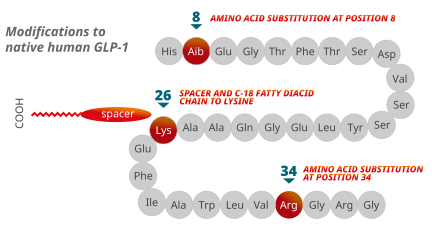
At the physiological level, semaglutide works by mimicking the natural incretin hormone GLP-1. This hormone regulates blood glucose and appetite by stimulating insulin secretion when glucose levels are elevated, suppressing glucagon release, and slowing gastric emptying. These coordinated biochemical effects reduce blood sugar spikes and increase satiety.          Ozempic® Molecule

Figure 1. Molecular representation of Ozempic showing how the semaglutide structure is designed to mimic GLP-1 and interact with GLP-1 receptors through specific molecular shape and binding sites. The diagram highlights the importance of structure–function relationships in pharmaceutical chemistry, where small changes in molecular arrangement determine receptor activation, biological response, and drug stability in the  body.  

The function of Ozempic is fundamentally determined by molecular structure and intermolecular interactions. The active compound, semaglutide, is a synthetically modified peptide composed of amino acids arranged in a specific three-dimensional conformation. This structure is designed through pharmaceutical chemistry to closely resemble endogenous GLP-1 while improving stability.

From a chemical standpoint, the drug’s biological activity depends on molecular recognition, where semaglutide binds to the GLP-1 receptor through highly specific non-covalent interactions such as hydrogen bonding, ionic interactions, and hydrophobic effects. These weak forces determine binding affinity and receptor activation, meaning that even minor structural changes can significantly alter pharmacological activity.

A key chemical modification is the increase in metabolic stability. Natural GLP-1 is rapidly degraded by the enzyme dipeptidyl peptidase-4 (DPP-4), resulting in a very short half-life. Semaglutide is engineered with structural changes that reduce enzymatic recognition and slow degradation, extending its half-life to allow once-weekly dosing. This is an example of structure-based drug design, where molecular modifications are used to control reaction pathways in biological systems.

Media coverage of this medication often reflects a tension between scientific advancement and public concern. Reports highlight significant therapeutic benefits, but also emphasize risks, accessibility issues, and social debates about cosmetic versus medical use.

From a chemistry communication standpoint, the framing can influence perception. When discussion focuses only on side effects, it may reinforce chemophobic thinking, the assumption that synthetic molecules are inherently harmful or “unnatural.” However, when the mechanism is explained in chemical terms, it demonstrates that the drug is a precisely engineered molecule designed for a specific receptor target. This challenges chemophobia by showing that biological effects arise from predictable molecular interactions rather than vague notions of “chemicals being bad.”

This topic is well-suited for a chemistry-in-the-human-environment course because it connects molecular structure, enzymatic reactions, and receptor chemistry to a widely discussed modern pharmaceutical. It also demonstrates how chemical design directly impacts human physiology and how media framing can shape public understanding of chemical science.

https://www.novomedlink.com/diabetes/products/treatments/ozempic/about/mechanism-of-action.html 

https://amp.cnn.com/cnn/2023/10/05/health/weight-loss-drugs-serious-digestive-problems


Tuesday, April 7, 2026

How Funding Cuts Are Disrupting the Next Generation of Chemists

In a typical year, the path to a PhD in chemistry is demanding but predictable. Students in their senior year of undergrad apply in the fall, hear back in the winter, and commit by spring, often April 15th. Typically PhD offers, especially in stem, come with research funding, lab placements, stipends enough to live within the area, and a clear next step into research careers.

 With unstable federal research funding: Now is different.


Across the United States, chemistry graduate admissions have been thrown into uncertainty about their futures in academia. Students are being accepted and then waitlisted, others are receiving offers, only to have them rescinded weeks later and some aren't hearing back from all their schools until far after the April 15th commitment deadline, making decisions difficult. Some programs have even quietly reduced their incoming class sizes or have canceled admissions entirely.

Universities rely heavily on federal agencies to fund graduate education in the sciences and these funds don’t just pay for experiments but they support stipends, tuition, and the infrastructure that keeps labs running. Recently, however, funding has become uncertain due to cuts, delays, and policy changes which have left universities unsure of what resources they’ll actually have in the coming years. Faced with that uncertainty, many departments are making a difficult choice to prioritize current students over incoming ones. From an administrative standpoint, it’s a defensive move. From a student’s perspective, it’s destabilizing with the consequences being immediate and personal.

Students who once felt secure in their plans are now navigating a confusing landscape:

  • Acceptance letters that don’t materialize into official offers

  • Waitlists that replace earlier admissions decisions

  • Deadlines that suddenly disappear

  • Programs that reverse course after commitments have already been made

No matter the qualification of candidates, everyone is affected. In some cases, universities have rescinded offers because they can no longer guarantee funding for stipends which is an essential component of most PhD programs.

This results in a cycle defined not by competition alone, but by unpredictability forcing students to rethink their futures. While some students are considering taking unplanned gap years, others are abandoning graduate school entirely in favor of industry roles, even if those positions are limited to entry-level work without an advanced degree.

For many, the concern isn’t just this year but it’s what comes next. If fewer students are admitted now, the next admissions cycle could become even more competitive, as a backlog of applicants collides with a new graduating class. If every year there's more applicants and limited spots, the Chemistry PhD becomes a rarity and what was already a narrow pathway into academia is becoming narrower still.

Still, it's too early to know whether this is a short-term disruption or the beginning of a longer shift in how scientific training is funded and structured, what is clear is that the current moment is testing the resilience of both institutions and students. Professors are advising patience, students are weighing backup plans ,and the future of the academic pipeline remains uncertain.

https://cen.acs.org/careers/employment/Chemistry-majors-stress-over-futures/103/i9

Photo: https://cen.acs.org/careers/US-science-research-gutted-2025/103/web/2025/08