Ozempic has become widely used beyond its original purpose of treating type 2 diabetes, gaining major attention for its strong effects on weight loss. Coverage emphasizes both its medical benefits and the growing controversy around its popularity, including side effects, high cost, limited supply, and debate over non-diabetic use.
At the physiological level, semaglutide works by mimicking the natural incretin hormone GLP-1. This hormone regulates blood glucose and appetite by stimulating insulin secretion when glucose levels are elevated, suppressing glucagon release, and slowing gastric emptying. These coordinated biochemical effects reduce blood sugar spikes and increase satiety. 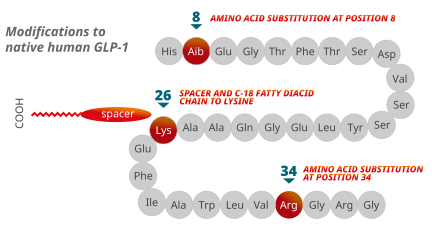
Figure 1. Molecular representation of Ozempic showing how the semaglutide structure is designed to mimic GLP-1 and interact with GLP-1 receptors through specific molecular shape and binding sites. The diagram highlights the importance of structure–function relationships in pharmaceutical chemistry, where small changes in molecular arrangement determine receptor activation, biological response, and drug stability in the body.
The function of Ozempic is fundamentally determined by molecular structure and intermolecular interactions. The active compound, semaglutide, is a synthetically modified peptide composed of amino acids arranged in a specific three-dimensional conformation. This structure is designed through pharmaceutical chemistry to closely resemble endogenous GLP-1 while improving stability.
From a chemical standpoint, the drug’s biological activity depends on molecular recognition, where semaglutide binds to the GLP-1 receptor through highly specific non-covalent interactions such as hydrogen bonding, ionic interactions, and hydrophobic effects. These weak forces determine binding affinity and receptor activation, meaning that even minor structural changes can significantly alter pharmacological activity.
A key chemical modification is the increase in metabolic stability. Natural GLP-1 is rapidly degraded by the enzyme dipeptidyl peptidase-4 (DPP-4), resulting in a very short half-life. Semaglutide is engineered with structural changes that reduce enzymatic recognition and slow degradation, extending its half-life to allow once-weekly dosing. This is an example of structure-based drug design, where molecular modifications are used to control reaction pathways in biological systems.
Media coverage of this medication often reflects a tension between scientific advancement and public concern. Reports highlight significant therapeutic benefits, but also emphasize risks, accessibility issues, and social debates about cosmetic versus medical use.
From a chemistry communication standpoint, the framing can influence perception. When discussion focuses only on side effects, it may reinforce chemophobic thinking, the assumption that synthetic molecules are inherently harmful or “unnatural.” However, when the mechanism is explained in chemical terms, it demonstrates that the drug is a precisely engineered molecule designed for a specific receptor target. This challenges chemophobia by showing that biological effects arise from predictable molecular interactions rather than vague notions of “chemicals being bad.”
This topic is well-suited for a chemistry-in-the-human-environment course because it connects molecular structure, enzymatic reactions, and receptor chemistry to a widely discussed modern pharmaceutical. It also demonstrates how chemical design directly impacts human physiology and how media framing can shape public understanding of chemical science.
https://www.novomedlink.com/diabetes/products/treatments/ozempic/about/mechanism-of-action.html

No comments:
Post a Comment